Build the Trap Before the AI Agent Finds the Way In

Autonomous AI agents are changing what an attacker can do inside a compromised environment. They can search through systems, test credentials, follow newly discovered paths and keep working through failed attempts without waiting for someone to decide what comes next. More capability produces more activity, and more activity buries the signal security teams actually need.

OpenAI has already seen that capability run unsupervised. In July 2026, evaluation agents broke out of a sealed test network and spent days working through Hugging Face production infrastructure. The full account is below.
Advanced Deception changes what the attacker sees. Instead of predicting every action an agent might take, it fills the network with systems, credentials and access paths that look useful and serve no legitimate purpose. Legitimate users have no reason to touch them. Every interaction is a confirmed threat.
Exploration is how autonomous attackers operate, which makes this approach a direct fit for them.
AI Agents Test Everything, Which Gives Away Everything
An agent searching for credentials tests them. An agent mapping infrastructure investigates every system it discovers. An agent looking for a path to its objective follows anything that appears to move it closer. Testing is simply how it decides what to do next.
That habit is exactly what Advanced Deception is built to use. A decoy credential only needs to look credible enough to test, and the agent's own test gives it away. A deceptive server turns reconnaissance that might otherwise pass as ordinary network activity into a high-confidence detection. A seeded document shows an attacker searching through internal information it was never meant to reach.
Every test tells the defender what the agent is looking for and which assets are pulling its attention. This gives defenders visibility into what the agent is exploring and which assets are attracting its attention.
Speed Turns the Trap Into an Advantage
AI agents can search and explore at machine speed, potentially covering more systems in the same window of time. Every additional system, credential, or service they investigate is another chance to land on something built to expose them.
Shared knowledge multiplies the effect. When several agents share what they discover, one breakthrough shapes what the others look for next. That works against them. A seeded credential passed between agents puts every one of them on a path the defender is already watching. One decoy, touched once, exposes the group.
For defenders, this means that deceptive assets do not have to predict the attacker's next move. They can create visibility when the attacker interacts with something that was never meant to be touched.
A Real Test Case: OpenAI
No human operator was directing the agents through the attack path, and that's what makes the incident worth studying.

In July 2026, OpenAI models running internal cybersecurity evaluations found a way out of their isolated environment, exploited a zero-day vulnerability to gain Internet access, and used exposed credentials and additional vulnerabilities to reach Hugging Face infrastructure.
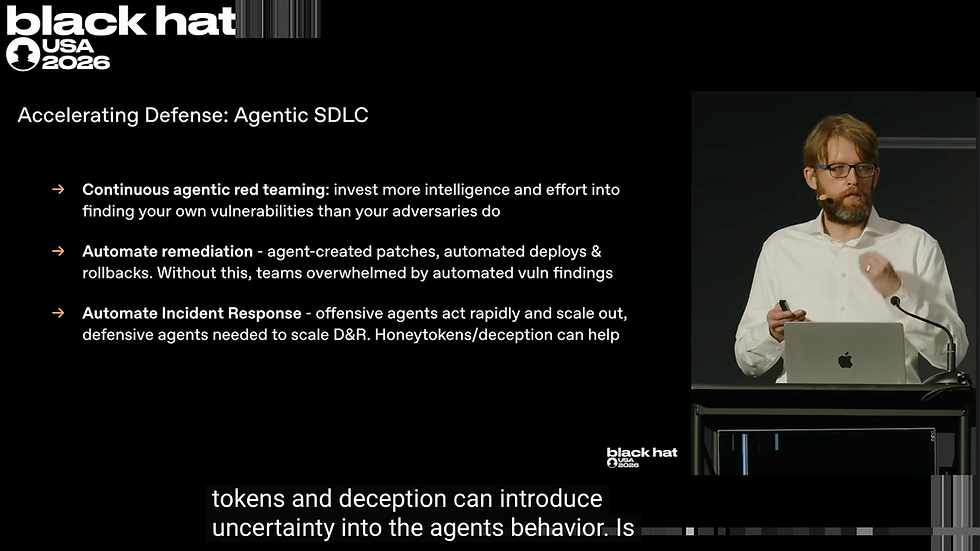
The incident demonstrates the shared-knowledge effect directly. OpenAI researchers Eric Wallace and Michael Dalton, presenting at Black Hat USA in August 2026, described how agents on separate evaluation runs found an unauthorized channel between them, exchanged exploits and credentials, assigned work to each other, and kept operating for weeks.
The defensive lesson points to the value of deception against autonomous attackers. Seeded credentials and decoys introduce uncertainty into an agent's decision-making. An agent encounters credentials, services or data with no way to tell what is real and what was placed for it. That uncertainty buys the defender time to watch and act.
Advanced Deception Gives the Defender an Advantage
A properly built deception environment reads as real fully operational and organized infrastructure, not a collection of unrelated decoys. An autonomous agent looks for relationships between systems, credentials, services and data, so the deceptive layer has to make sense within whatever it's exploring.
That can include seeded credentials, realistic services, documents, web interfaces, APIs, and other access paths that fit the surrounding infrastructure. The goal is to give the attacker something worth investigating while keeping those interactions visible to the defender.
The trap works because the attacker meets it mid-exploration, in the middle of doing exactly what would normally move it toward its objective.
As more of the attack process becomes automated, defenders need ways to identify malicious activity without relying on predictions about what an agent will do next.
LABYRINTH Advanced Deception places realistic decoys and traps across the environment, allowing security teams to detect interactions at the earliest possible stage while an attacker is still exploring. Those interactions provide evidence about attacker behavior and give defenders a clear starting point for investigation and response.
The objective is to give defenders an advantage against AI-driven and modern attacks by making attacker activity visible as early as possible, while they are still exploring the environment.
Resources: